
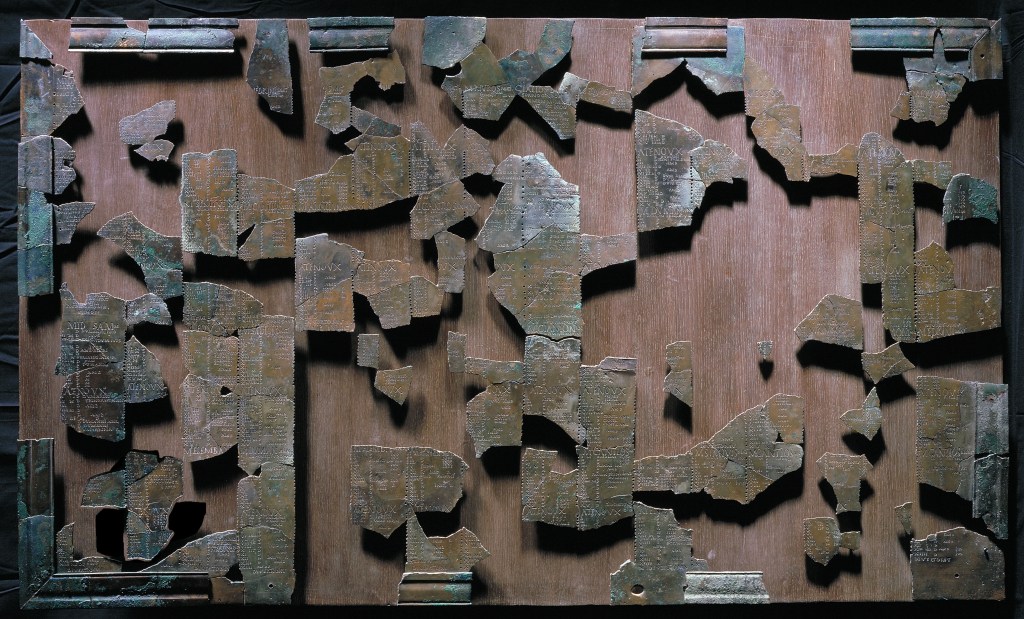
Extensive deliberations focus on how months and years commence in this calendar, which stands as a rare and precious relic of Gaulish timekeeping and religious order. Known as the Coligny Calendar, it was discovered in 1897 near the village of Coligny in the Ain department of eastern France, the ancient territory of the Sequani. The fragments were unearthed by chance, revealing a large bronze tablet inscribed with both Latin letters and Gaulish language. When reconstructed, the calendar measured nearly 1.48 meters wide and 0.9 meters high, containing over 2,000 engraved characters.
The artifact is generally dated to the late 2nd century CE, a period when Roman rule had already taken firm hold in Gaul but indigenous religious and cultural traditions persisted beneath the surface. This calendar stands as a testament to that resilience—a fusion of Roman craftsmanship and Gaulish cosmology. Today, the original fragments are preserved in the Musée de la Civilisation Gallo-Romaine (now the Lugdunum Museum) in Lyon, France, where they remain one of the most important relics of pre-Christian Celtic Europe.
The month sequence remains relatively consistent, featuring twelve months annually, with an additional intercalary month every fifth year. This cycle maintained harmony between the lunar and solar reckonings, ensuring that the agricultural and ritual seasons remained aligned with the movements of the heavens.
Each month is divided into two halves: the first half spans fifteen days, while the second half varies between fifteen and fourteen days, resulting in alternating months of thirty and twenty-nine days. The calendar commences with the first quarter moon, ensuring that both full and new moons occur within each month’s halves. However, ongoing scholarly debate continues regarding whether the cycle originally began with the new moon instead. Despite such differences in interpretation, the calendar’s operation follows a consistent five-year cycle, reflecting an enduring concern for balance, order, and cosmic alignment.
From a spiritual perspective, the Coligny Calendar represents more than a tool of measurement—it embodies the sacred rhythm of the cosmos. Each turn of the moon marked times for sowing and harvest, for ritual observance and renewal. The alternation between auspicious (matti) and inauspicious (anmatti) days expressed the belief that not all time was equal—some moments were inherently sacred, filled with divine favor, while others required stillness and restraint.
Within the modern spiritual community, many choose to adopt variations of the Coligny Calendar as their religious or ritual calendar. Others prefer to observe its essence symbolically, recognizing its deeper rhythm without strict adherence to its structure. Ultimately, the choice lies with the individual. Following the calendar does not bestow superiority, nor does abstaining from it imply spiritual deficiency. Rather, it invites each practitioner to engage with time intentionally—to see it as sacred space. Respecting diverse interpretations honors the living spirit of Gaulish tradition, which has always embraced plurality and local custom.
The twelve typical months are as follows:
(Some individuals commence the year with Samonios in November–December, marking the beginning of winter and the descent into the dark half of the year.)
- Samonios (May–June)
- Dumanios (June–July)
- Riuros (July–August)
- Anagantios (August–September)
- Ogronios (September–October)
- Cutios (October–November)
- Giamonios (November–December)
- Simiuisonna (December–January)
- Equos (January–February)
- Elembiuos (February–March)
- Aedrinios (March–April)
- Cantlos (April–May)
The intercalary months are added to maintain cosmic balance within the five-year cycle:
- Quimonios, preceding Samonios in the first year of the cycle
- Rantaranos, preceding Giamonios in the third year of the cycle
Months containing thirty days are considered Auspicious (MAT), signifying favorable periods for action, travel, and ritual engagement. Months of twenty-nine days are deemed Inauspicious (ANM)—times better suited for contemplation, rest, and preparation.
Additional markings found upon the Coligny Calendar include:
- IVOS – Denoting Holidays or Festivals, sacred days of offering and communal gathering.
- MD – Matti Dîuos, literally “Good Day,” propitious for ritual or important undertakings.
- AMB – Anmatti Dîuos, “Not Good Day,” indicating periods when action should be avoided or the divine currents are less favorable.
Through these markings, the Coligny Calendar reveals the Gaulish vision of time as both cyclical and alive—a sacred dialogue between moon and sun, day and night, Samos and Giamos. To study and follow it is not merely to count days but to walk in rhythm with the cosmos itself.
All the Gauls assert that they are descended from the god Dis, and say that this tradition has been handed down by the Druids. For that reason they compute the divisions of every season, not by the number of days, but of nights; they keep birthdays and the beginnings of months and years in such an order that the day follows the night.
Cæsar, C. J., “De Bello Gallico”, vi, 18, 1
On the fifth day of the moon, the day which is the beginning of their months and years, as also of their time cycles, which, with them, are only thirty years. This day they select because the moon, though not yet in the middle of her course, has already considerable power and influence.
Pliny , “Nat. Hist.”, xvi, 249
Useful Resources
- In the Gaulish Tradition Bessus Nouiogalation, much work has been dedicated to understanding and restoring this ancient system. Their efforts include developing a Calendar App and structuring their modern holidays around the IVOS clusters found upon the original bronze tablet. For the BNG, the Coligny Calendar is not viewed as an outdated artifact but as a sacred relic—a key to the Gaulish worldview that once bound community, nature, and divinity into one living rhythm. For those wishing to explore further, additional resources and tools are available through their site:
- Cunolugus, the Brennos of Galatîs Litauiâs, has delved deeply into this work, carefully mapping out all the holiday clusters preserved upon the Calendar. His research and devotion have illuminated how these sacred periods align with the rhythm of the moons, the seasons, and the divine patterns of Samos and Giamos.
- Likewise, Tegos Skrībbātous has dedicated significant effort to reconstituting the Calendar, producing a reconstructed tablet image that brings new life and accessibility to this ancient artifact. Their meticulous work allows modern practitioners and scholars alike to visualize the calendar as it may once have appeared, bridging the gap between ancient craftsmanship and modern devotion.




 Gaulish Paganism